Ernst Caramelle
Figures of Thought
-
Curator: Jürgen Tabor, Generali Foundation Collection
Venue: Museum der Moderne Salzburg, Rupertinum, Generali Foundation Study Center
Ernst Caramelle (*1952) is one of the leading figures of Austrian Conceptual art. Since the 1970s, he has worked between Europe and the United States, exploring the relationships between reality and illusion, image and space. With analytical precision and subtle humor, his work asks how art is defined, where it takes place, and how we perceive it.
The study exhibition Figures of Thought focuses on two central bodies of work by Ernst Caramelle: his artist’s books, posters, and invitation cards from 1974 to 2025, and his early photographic series Video-Landschaften (Video Landscapes) from 1974.
For Caramelle, artist’s books, posters, and invitation cards are not merely accompanying materials or documentary by-products. He conceives of them as autonomous works: as mobile spaces of art, vehicles for ideas and questions, and sites in which the relationships among artwork, institution, and audience are continually renegotiated. Already in his early works, Caramelle’s artistic thinking unfolds through combinations of text, drawing, and photographic image that make processes of reflection visible. Over the decades, he developed a distinctive vocabulary of recurring forms and methods—the “figures of thought” that give the exhibition its title: mirroring and doubling, positive and negative, the characteristic zigzag form, and Faces composed of just two dots and a line. Recurring alter egos, such as Tel, the seahorse, and the figure Josef Troma, lend this conceptual vocabulary a playful, often wryly comic note.
The Generali Foundation Collection has devoted particular attention to this area of Caramelle’s practice. Today it holds more than 130 artist’s books, posters, invitation cards, and media interventions by the artist. Seventy works from this group are presented in this compact study exhibition. Selected artist’s books are also available as reading copies.
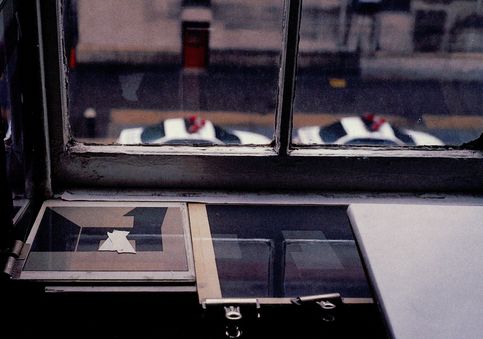
The photographic series Video-Landschaften (Video Landscapes, 1974), made in the same year as Caramelle’s first artist’s books, forms a resonant counterpart to his printed works in the exhibition. It was produced during a yearlong stay in the United States, which brought Caramelle, among other places, to the Center for Advanced Visual Studies at the Massachusetts Institute of Technology in Cambridge—an experimental international environment at the intersection of art and technology. The series documents experiments with video, then still a new medium. Television monitors are placed in different constellations with the artist’s body, the surrounding space, and the camera’s image. Each monitor shows precisely the section of reality it conceals, making it appear like a pane of glass. The result is an optical illusion that shifts the boundaries between reality and mediality, perception and deception. Video-Landschaften formulates questions that continue to shape Caramelle’s work and also resonate in his books, posters, and cards: What do we actually see? Where do reality and illusion, image and space begin and end?
Biography
Ernst Caramelle was born in Hall in Tirol in 1952 and grew up in Brixen im Thale. After training at the Glasfachschule Kramsach, he studied from 1970 to 1976 at the Hochschule für angewandte Kunst in Vienna. In 1974–75, he undertook a research stay in the United States; in the context of the Center for Advanced Visual Studies at MIT in Cambridge, he created early video works such as
“Video-Landschaften” and “Video-Ping-Pong”. In 1979, Caramelle established a studio in New York and published the artist’s book “Forty Found Fakes”; around this time, he also developed his first Faces, composed of two dots and a line. Since the 1980s, he has increasingly expanded his practice into space, bringing together painting, architecture, time, and light in wall paintings,
“Gesso Pieces”, and “Sun Pieces”. Alongside his artistic work, Caramelle has shaped several generations of artists as a teacher, including at the Städelschule in Frankfurt am Main, the University of Applied Arts Vienna, and the State Academy of Fine Arts Karlsruhe, where he served as rector from 2012 to 2018. His work has been presented internationally in numerous institutional exhibitions; in 1992, he participated in documenta IX in Kassel. Ernst Caramelle lives and works in Frankfurt am Main, Germany, and New York, USA.