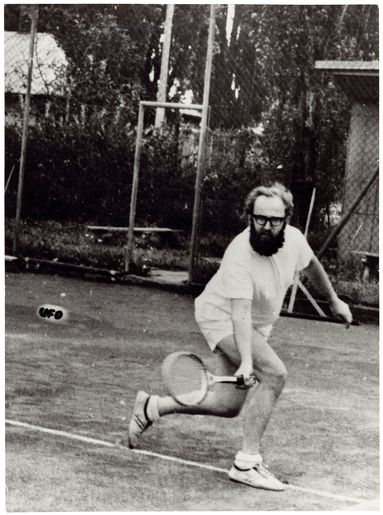
Aus der Serie "Anti Happening" (Tennis)


Julius Koller
Aus der Serie "Anti Happening" (Tennis), 1963-71
8 black-and-white photographs, Vintage prints on baryta paper, some photo montages
WG0030512.00.0-2005
Artwork text
From the 1960s, the keen athlete Július Koller started using tennis and table tennis as symbols of democratic communication. He viewed private sports and games as a cultural situation expressing fundamental principles: fairness as a basic attitude, a dialogue of opinion conducted via the back and forth of the ball, the interplay of body and mind in sporting activity, the preparation of the court as an existential act. In March 1970, Koller turned the Galéria mladých (Gallery of Youth) in Bratislava into the J. K. Ping-Pong Club. The club dissolved the boundaries between sport and art and was a statement against the end of the democratization process in the Czechoslovak Socialist Republic (ČSSR), marked by the crushing of the Prague Spring in 1968. From the 1970s, Koller made obsessive use of symbols such as Ping-Pong rackets, the question mark, and variations of the acronym “U. F. O.”(“Universal-Cultural Futurological Operations”) to make a stand against the sense of general resignation during the period of Communist “normalization” in the ČSSR (1972–1989). (Jürgen Tabor)