The Ash and the Elm
Bethan Huws
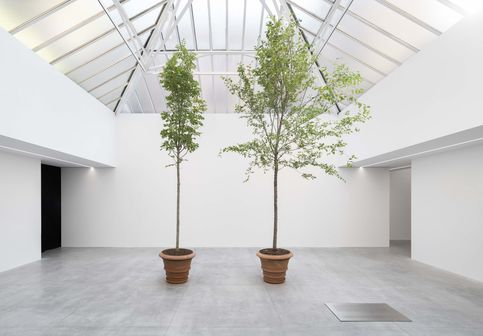
The Ash and the Elm, 2022
Installation, the work can be exhibited both indoors and outdoors; Stainless steel plate with engraved text, trees, pots, base plate (A+ quality metal plate suitable for outdoor use), 60 x 100 cm, Edition 1/3 (+ 1 A.P.), Dimensions variable
GF0031907.00.0-2025
Artwork text
The installation “The Ash and the Elm” is a representative work of Bethan Huws’s artistic practice in the Generali Foundation Collection. The title refers to two trees that are deeply rooted in Celtic and European mythology and carry different cultural connotations in English and Welsh. Words cannot always be translated one-to-one from one language to another. This openness creates room for interpretation, generates misunderstandings, and holds poetic potential. The title creates a context in which meaning emerges without ever being definitively fixed. This is precisely the terrain Wittgenstein describes: “Meaning is not a fixed entity, but a process.” In his 1969 publication "On Certainty", Wittgenstein reasons as follows in point 649: “I once told someone—in English—that the shape of a certain branch was typical of the branch of an elm, which my companion denied. Then we came past some ashes, and I said ‘There, you see, here are the branches I was speaking about.’ To which he replied ‘But that's an ash’ - and I said 'I always meant ash when I said elm.’”1 Huws engraves this quotation onto a metal plate and incorporates it as an integral part of her installation. In doing so, Wittgenstein’s influence is not made visible as a direct illustration of his philosophical theses, but rather serves as a methodological basis: “The Ash and the Elm” is characterized by simplicity, precision, and a capacity for conciseness. The installation has no unambiguous meaning; rather, it is an example of a work of art that explores openness as an aesthetic principle in dialogue with Wittgenstein. (Doris Leutgeb) 1 Ludwig Wittgenstein, On Certainty. Edited by G.E.M. Anscombe and G.H. von Wright, translated by Denis Paul and G.E.M. Anscombe. Oxford: Basil Blackwell 1969