The Basis for a Song
Wendelien van Oldenborgh
The Basis for a Song, 2005
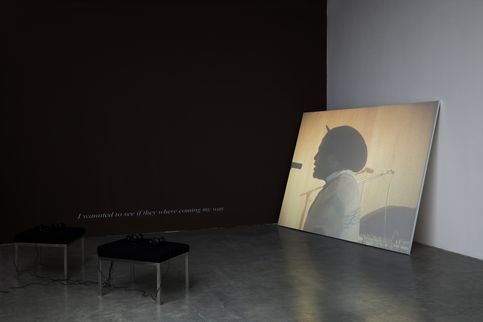
Installation, slide projection 149 slides, 35mm, color, made of video stills, 3 Kodak-Carousel Ekta Pro 5000 slide projectors, Sound, Dutch with English subtitles, scale 4:3, 24 min, Loop Projection area: approx. 300 x 225 cm Cast: Milford Kendall, Romeo Gambier Edition 1/2 + 1 A.P.
GF0031168.00.0-2010
Artwork text
working processes. Together with groups or individuals who bring their own knowledge and personal experiences, she develops scripts on contemporary social and political themes. The participants also become actors in the films, videos, and slide essays, most of which are shot at a politically or historically charged location. The Basis for a Song was directed at Waterfront Studios in Rotterdam. The location is linked to the squatter movement of late 1970s and early 1980s Rotterdam. In the context of the punk movement and due to the acute housing shortage, unused or dilapidated buildings were occupied without approval and adapted according to the squatters’ own requirements; this was often tolerated by the municipal government at the time to avoid open political conflict. In The Basis for a Song, two rappers from the young hip-hop scene, Milford Kendall (a.k.a. Scep) and Romeo K. Gambier (a. k.a. Mixmaster Fader), work on a song about Rotterdam’s squatters in the 1970s. They draw a line from the past to the present where economic motives and urban renewal projects determine who is welcome in the city and who is not. While initially it was anarchist movements that sought a place in the city, in the multinational Rotterdam of the 1980s onward, it has mostly been people with migration backgrounds who have had to attempt to navigate a space that gives preference to high-income groups. (Jürgen Tabor)