BAU I
Ulrike Grossarth
BAU I, 1989-2000
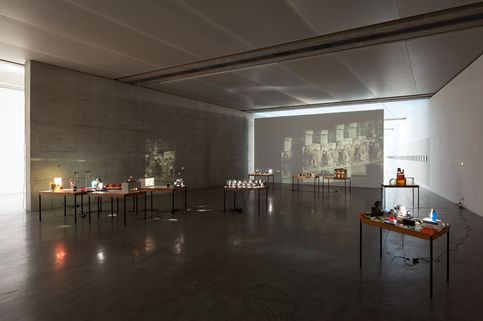
Installation, slide projection 10 tables, 17 projectors, various articles, books, iron casted plates, paper objects, foams, 5 big glass blocks (from the 1930ies), 1 small sculpture (Ideal bed) colored glass plates, plaster molds, mirrors, 1 lamp, slides (street in Berlin of the middle of 1989 and lightforms Dimensions variable
GF0031075.00.0-2009
Artwork text
Ulrike Grossarth’s sculptural works are shaped by her many years of training and practice as a dancer. Before 1987, she conceived and realized performances, actions, and dance pieces. After that, she developed bodies of work in which she transferred spatial and temporal modes of perception from dance into detailed ensembles loaded with historical context. In the artist’s oeuvre, BAU I (CONSTRUCTION I) is a central, experimental arrangement of various objects constellated over a period of ten years. The ensemble, consisting of objects, light, shadow, and projections, can only be experienced and understood in constant motion. Goods, everyday objects, food and its packaging, casts, glass, mirrors, and technical devices, as well as projections, photographs, silhouettes, and colors form a conglomerate of the material and immaterial, real and fictional, object, function, and meaning. Just as there are multiple ways of exploring the installation, there are likewise multiple intercorrelating ways of interpreting it: through an art, cultural, and intellectual-historical lens, as well as a phenomenological interpretation based on the appearance of things.1 Grossarth describes her many years working on the body of work BAU I as follows: “In 1990, I started to explore the concept of the object in the twentieth century: from Duchamps’ industrial product as a finished good to the cult of commodity fetishism and the status of the object as symbol and code. However, I was interested in a form of intervention where the space becomes indistinguishable from the object, thus creating ways of perceiving and experiencing that are not predicated on both aspects being separated.”2 (Jürgen Tabor) 1 Mieke Bal, “Modus Vivendi oder Das unvollendete Geschäft der Geschichte,” in Ulrike Grossarth: Wäre ich von Stoff, ich würde mich färben / Were I Made of Matter, I Would Color, ed. Sabine Folie and Ilse Lafer, exh. cat. (Vienna: Generali Foundation; Berlin: Sternberg Press, 2014), 47. 2 Ulrike Grossarth, 1, 2, 3, 4, 5 – Umgebung: Arbeiten 1986 bis 2005, exh. cat. (Berlin: Hamburger Bahnhof – Museum für Gegenwart; Cologne: König, 2006), 74.