Genealogie des Ungreifbaren


Franz West
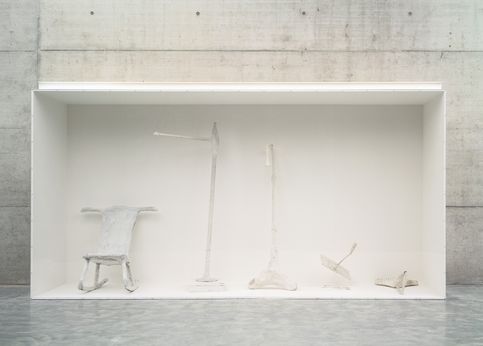
Genealogie des Ungreifbaren, 1997
Installation, Display case for five "Adaptives", (GF0000070.00.0-1991, GF0000112.00.0-1994, GF0000111.00.0-1994, GF0000106.00.0-1994, GF0000105.00.0-1994), particle board, metal beams, varnished white, perspex, 215 x 405 x 100 cm
GF0001862.00.0-1997
Artwork text
Franz West was born in Vienna, Austria, in 1947. From 1977 to 1982, he studied at the Academy of Fine Arts in Vienna under Bruno Gironcoli. He cultivated strong connections with writers and musicians who, alongside the Vienna School of Psychoanalysis in the tradition of Sigmund Freud and the philosopher Ludwig Wittgenstein, had a formative effect on him. In the mid-1970s, West challenged and expanded the term “sculpture,” developing his Passstücke (Adaptives)—sculptures with no specific function formed from everyday objects with wire, papier-mâché, plaster bandages, and polyester. The artist viewed them as utensils that could be handled and placed on the body, calling them “neuroses made visible” and “body-extending prostheses.” It is through interaction that they first become art. For the exhibition postproduction at the Generali Foundation in Vienna in 1997, West constructed a museum vitrine to protect a group of Passstücke from the Generali Foundation Collection. The front is closed like a shop window, making the artist’s original aim—of allowing the works to be handled—impossible. Genealogy is one of the auxiliary sciences of history. Genealogists or family historians explore and represent human relationships. Making reference to this with the title Genealogie des Ungreifbaren (Genealogy of the Untouchable), West presents the potential relationships between his Passstücke. In the late 1980s, Franz West filmed people from his family and friendship circle handling his Passstücke to a soundtrack of classical music. According to the artist, “It was intended as a representation of neuroses. I would assert that if neuroses could be made visible, they might look like this.”1 The eight-millimeter films were projected onto the wall and filmed with video. Distancing effects and distortions in the picture were embraced. Originally, the music served as inspiration for the actors and their interactions with the Passstücke. Later, the artist decided to show the videos without sound, isolating the motion sequences from illustrative music to create silent acrobatic gestures, thus heightening the optical effect. The motion sequences therefore look highly experimental and—in defiance of all choreography—entirely random, corresponding to the raw surfaces of the Passstücke, which bear the traces of their manufacture, forgoing any perfectionism. (Doris Leutgeb) 1 Franz West, “Franz West,” in Occupying Space. Sammlung Generali Foundation Collection, ed. Sabine Breitwieser (Cologne: König, 2003), 560.