Mein Schlafzimmer in Prag


Dorit Margreiter Choy
Mein Schlafzimmer in Prag, 1993
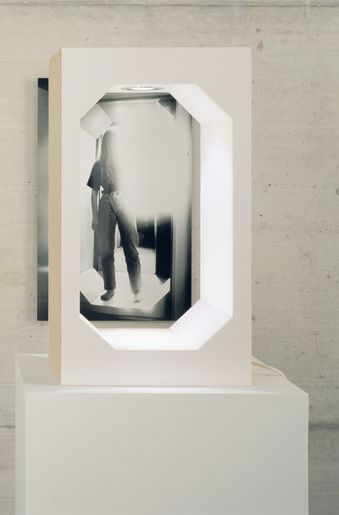
Model of the installation at Forum Stadtpark, Prague 4 parts Object, cardboard, integrated lighting, 50 x 28 x 19.6 cm black-and-white photograph, cibachrome, dry-mounted on aluminum 50 x 32 cm 2 pages text, 29.7 x 21 cm each, in German/English and Czech/English Invitation card
GF0000279.00.0-1997
Artwork text
The installation Mein Schlafzimmer in Prag (My Bedroom in Prague) from 1993 is Dorit Margreiter Choy’s first solo exhibition. In this installation, the themes and aspects that define the artist’s subsequent work are already manifest. This includes explorations of architecture as socially and ideologically defined space and the influence of Modernism on contemporary everyday life, and references to the global circulation of identity politics imagery through film and TV. In Mein Schlafzimmer in Prag, Margreiter Choy takes as her theme her living and work situation in Prague at that time. At the start of the 1990s, an apartment in a residential building in inner city Prague was rented by the Austrian cultural institution Forum Stadtpark Graz, which invited artists to use it as a retreat, a place of work, and exhibition space. In practice, the anteroom was used as an exhibition space, while the adjacent bathroom, kitchen, and bedroom were available as living space. Here the public and private existed side by side, separated only by a few steps and a simple living room door. The title of Margreiter Choy’s installation refers to a situation confronted by Lina Loos at the beginning of the twentieth century. In 1903, her husband Adolf Loos, a pioneering architect of Vienna Modernism, published the bedroom designed by him for Lina in a design journal. This was unusual in that the photograph related to the most intimate room and Loos generally refused to have his interior designs photographed since their multifaceted structures were meant to be experienced only “in reality.” Margreiter Choy highlights the paradoxical situation of her Prague apartment, where she installs a model teleportation cabinet in the entrance hall—a threshold area evocative of a “transporter” capsule made popular in the 1960s and 1970s in science fiction. The teleportation area, which visitors need to walk through to reach both the apartment and the exhibition space, functions as a portal that visualizes the permeability between outside and inside, public and private. (Jürgen Tabor)