Ping Pong
VALIE EXPORT
Ping Pong, 1968
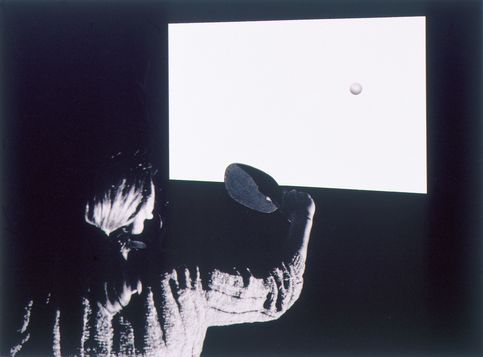
"TV action" after the film action of the same name, Video-installation, Video player, video monitor, video, black and white, silent, table tennis racket and ping pong balls, 2 min 30 sec (loop), Dimensions variable, approx. 155 x 67 x 70 cm
GF0000230.00.0-1997
Artwork text
The pioneering media artist VALIE EXPORT has questioned and changed the conventions of cinema and film more than almost any other artist. Since the late 1960s, her media and socially critical works have set new international standards. She exposed the domineering, patriarchal, capitalist nature of traditional television and cinema and its associated objectification of the female body. With radical actions, experimental films, and feature films, she broke through the subjection of a male, chauvinist gaze to develop a countercultural media and cinematic language. Ping Pong belongs to VALIE EXPORT’s early group of expanded cinema works. In 1968, the film action was awarded the Prize for the Most Political Film at the second Maraisiade of Young Austrian Film in Vienna. Using simple means, observers are physically removed from their passive role. Equipped with a Ping-Pong racket and ball, they need to try to hit the dots that appear spontaneously on a screen or TV. The film action to some extent anticipates the interactive computer games of the future. In terms of content, it shines a light on the domineering relationship between producer and consumer. The viewers leave their passive role and become partners in an entertaining game. However, this is a deceptive freedom, as they simply find themselves in a new stimulus-response pattern. In this sense, Ping Pong offers illumination rather than liberation. (Jürgen Tabor)