Franz Xaver Ölzant
Franz Xaver Ölzant was born in 1934 in Oberzeiring, Styria (Austria). From 1955 to 1958, he studied at the University (then College) of Applied Arts in Vienna. From 1978 to 1982, he continued his studies at the Academy of Fine Arts in Vienna. From 1986 to 2001, he held a professorship in sculpture there.
He received numerous awards, including the City of Vienna Prize for Sculpture in 1980, the State of Styria Award for Fine Arts in 1989, and the Lower Austrian Culture Prize (Honorary Award) in 2005. Franz Xaver Ölzant lived in Vienna and Pfaffenschlag near Waidhofen an der Thaya in Lower Austria and passed away in 2026.
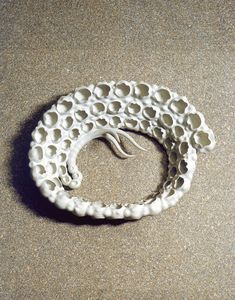
Franz Xaver Ölzant is considered one of the most significant Austrian sculptors of the post-1945 era and occupies a unique position within the field. In his early career, he initially worked in a figurative style, then increasingly turned to abstraction. Through his intensive exploration of organic processes and plant-like forms found in nature, he developed a formal language that is characteristic of his work. His works are characterized by the ambivalence of organic, biomorphic forms and abstract symbols that border on the ornamental.
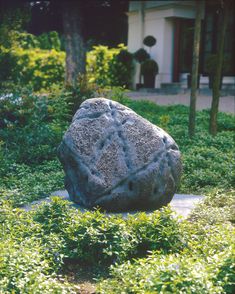
He worked with materials such as stone, wood, plaster, and bronze. He was particularly fascinated by granite boulders—large chunks of granite shaped by immense natural forces, such as those found in the Waldviertel region—which often served as his starting point. Into these archaic formations—silent witnesses to uncontrollable forces of nature—he imprinted structured patterns as well as biomorphic, open forms. These appear as markers of a civilizational appropriation and suggest a struggle between chaos and order, between wild nature and cultivated civilization. The Generali Foundation Collection includes “Der schöne Stein” (The Beautiful Stone), a representative example of this group of works. Its surface features the drill holes and linear marks characteristic of the artist’s style. Smoothly polished and rough areas coexist, inviting the viewer to explore them by touch. Due to their heavy weight, these sculptures are designed for outdoor display. As the seasons change, mosses and lichens will slowly recoat the stone’s surface. One characteristic of nature is its constant change. Humans can leave traces behind—as evidence of their existence. In the cycle of becoming and passing away, we understand ourselves as part of nature, in which everything is connected to everything else, and to which we are ultimately at the mercy of. As an artist, Ölzant was a poet who lent the spirit of nature order, aesthetic form, and a voice, without taming it. (Doris Leutgeb)